When connectivity returns, TRAK automatically syncs all buffered field data to a secure cloud portal and web dashboard — no manual exports, no data loss.
The base station buffers all incoming LoRa packets to local storage during deployment. When a WiFi network is detected, data is automatically batched and uploaded to the TRAK cloud backend, validated, and appended to the correct organisation's secure data store — sorted by device and date.
Researchers returning from the field can also trigger a manual upload via the mobile app.
Each organisation gets a PIN-protected data workspace in the cloud. Records are created automatically per date, with one entry per incoming packet.
| Timestamp | Device ID | Latitude | Longitude | Battery % | Heading ° | Speed km/h | RSSI dBm | Base Station |
|---|---|---|---|---|---|---|---|---|
| 07:14:22 | COLLAR-A04 | 13.48214 | 77.29431 | 87 | 218 | 0.8 | –82 | BS-01 |
| 07:14:38 | COLLAR-B09 | 13.49041 | 77.30112 | 61 | 192 | 1.4 | –89 | BS-02 |
| 07:28:03 | COLLAR-A04 | 13.48199 | 77.29387 | 87 | 221 | 0.6 | –84 | BS-01 |
| 07:28:19 | COLLAR-B09 | 13.49128 | 77.30244 | 60 | 188 | 2.1 | –87 | BS-02 |
| 07:42:11 | COLLAR-A04 | 13.48163 | 77.29310 | 86 | 225 | 1.1 | –81 | BS-01 |
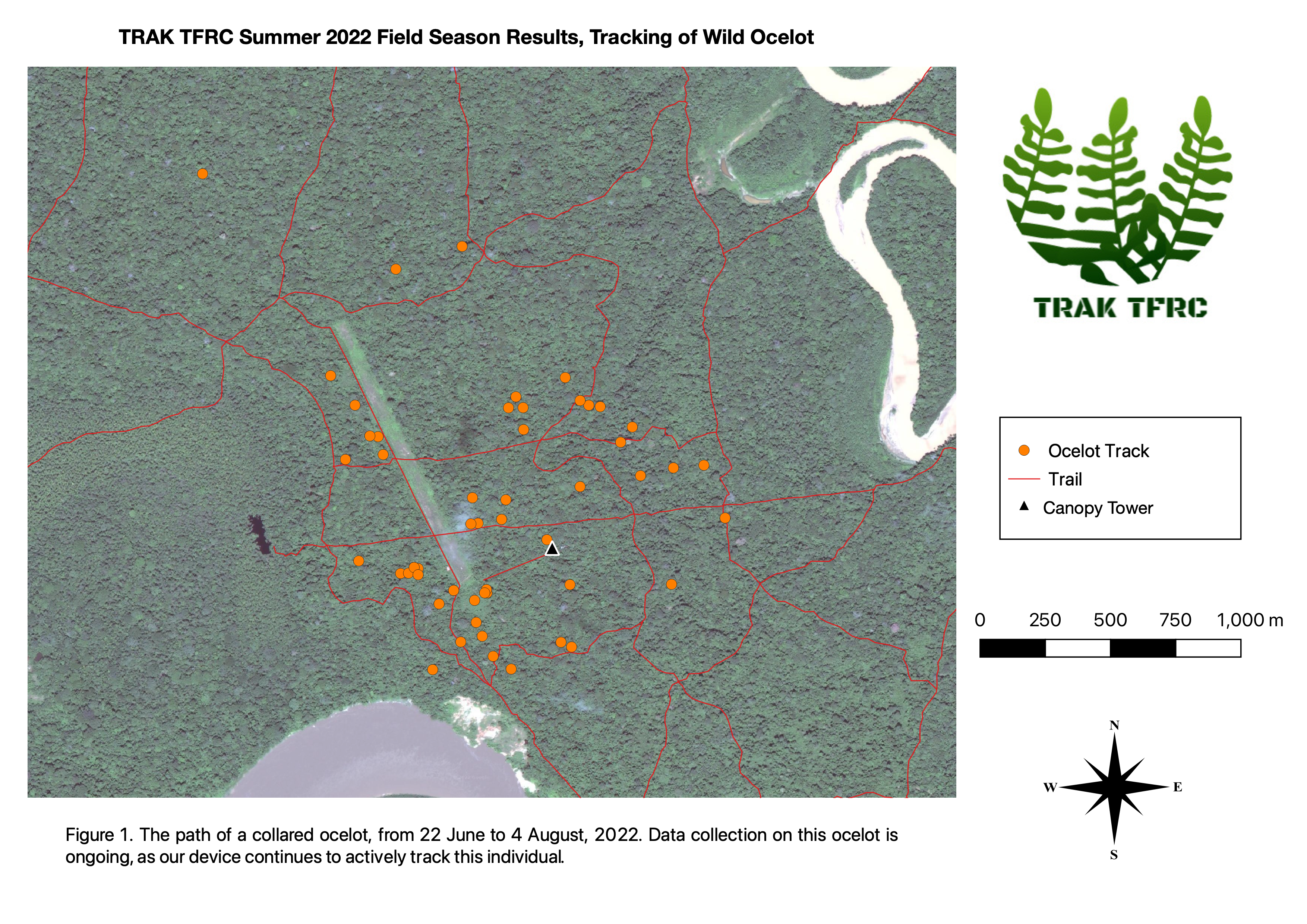
TRAK TFRC deployed tracking collars on wild ocelots during the Summer 2022 field season in the Amazon. The map shows GPS fixes collected from a single collared individual between 22 June and 4 August — revealing detailed movement patterns, territory use, and habitat preference across the study area.
Data collection on this individual is ongoing, with the device continuing to actively track and transmit.
All field data syncs automatically to a secure cloud portal — organised by organisation (PIN-protected), date, and device type. Accessible from any browser, no software to install.
Export collar tracking data to Movebank — the world's largest repository of animal tracking data — for long-term archiving, cross-study analysis, and publication support.
A web-based dashboard visualises device state, location history, battery trends, and trap events in real time — accessible to all authorised members of an organisation.
Multiple research organisations can operate from the same TRAK hardware deployment. Each organisation has its own PIN-protected workspace — data is segregated at the upload layer and never mixed.
This makes TRAK ideal for shared field stations, joint research programmes, and government–NGO partnerships.